A Complete History of Mars Missions: From Viking to Perseverance
The History of Mars Missions traces humanity’s journey from 1960s flybys to advanced rovers like Perseverance, revealing Mars’ climate, geology, and potential for past life.
For as long as humans have looked up, Mars has fascinated us. Its reddish glow set it apart from the other lights in the sky, earning it names tied to war, fire, and passion. But the real story began when telescopes showed it as a world, one with polar caps, shifting colors, and hints of weather.
By the early 20th century, people wondered if life existed there. When the space age began, we finally had a way to find out.
The journey wasn’t smooth. The first missions failed spectacularly. But each attempt taught us something. Each success, no matter how small, pulled the curtain back a little further on the mystery of Mars.
Let’s travel through time, from the earliest dreams to today’s robotic explorers, and uncover how our understanding of the Red Planet has evolved.
The Early Years (1960–1969): The Age of First Attempts
Before NASA or the European Space Agency landed a single robot, Mars was the ultimate challenge. Reaching it meant navigating millions of kilometers through space, surviving entry, and sending data back home, all with 1960s technology.
Soviet Pioneers: The First Tries
The Soviet Union launched a series of Mars probes starting in 1960 under the Mars program. None reached their destination successfully. Communication systems failed, rockets misfired, and early designs couldn’t survive the journey.
But these missions weren’t wasted, they built the foundation for every mission that followed.
Mariner 4: Humanity’s First Glimpse
In 1964, NASA launched Mariner 4, which became the first spacecraft to successfully fly by Mars. It reached the planet in July 1965 and sent back 21 black-and-white photos, humanity’s first close-up look at another planet.
The images were shocking: barren, cratered, and seemingly lifeless. The dream of Martian canals and civilizations vanished overnight.
Still, those 21 photos changed history. Mars was real. Tangible. And reachable.
The 1970s: The First Orbiters and Landers
After a decade of trial and error, the 1970s marked the era of successful Mars exploration.
Mariner 9: The First to Orbit Another Planet
Launched in 1971, Mariner 9 became the first spacecraft to orbit Mars. When it arrived, the planet was shrouded in a massive dust storm. For weeks, scientists saw nothing but haze. But as the dust cleared, breathtaking sights emerged: volcanoes taller than Everest and canyons wider than the United States.
It revealed features like Olympus Mons and Valles Marineris, confirming Mars was geologically active in the past.
Viking 1 and 2: First Landers on Mars
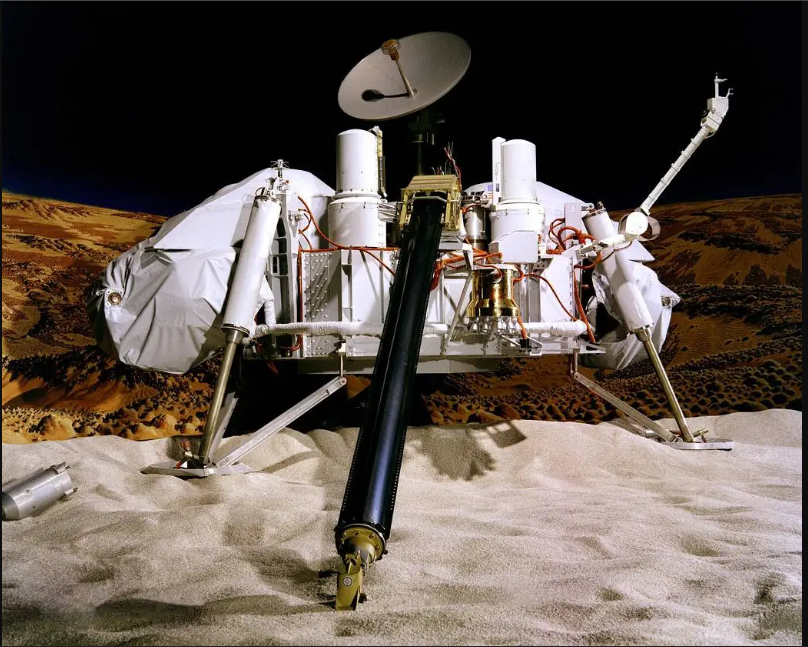
In 1976, NASA’s Viking program achieved the impossible, two orbiters and two landers successfully reached Mars.
Viking 1 became the first spacecraft to land and operate on Mars’ surface on July 20, 1976.
Viking 2 followed weeks later.
They analyzed soil samples, photographed the Martian landscape, and even searched for life. While no definitive signs of organisms were found, Viking gave us our first real understanding of Mars’ thin atmosphere and cold desert terrain.
The orange skies, rocky plains images became iconic.
According to NASA archives, Viking’s life-detection experiments sparked debates that continue to this day. Some scientists believe the results might have hinted at microbial activity.
The Quiet Years (1980–1990): Lessons in Patience
After the Viking triumphs, Mars exploration went quiet for nearly two decades.
Budgets were cut, new missions failed to launch, and focus shifted to the outer planets. The Red Planet waited patiently.
In 1988, the Soviet Union’s Phobos 1 and 2 missions aimed to study Mars and its moons. Phobos 1 lost contact before arrival, and Phobos 2 failed just before deploying its lander.
These setbacks reminded the world that Mars was still a harsh destination, not easily conquered.
The 1990s: Return to the Red Planet
After years of silence, the 1990s marked a revival. Technology had improved, and a new generation of scientists was eager to try again.
Mars Global Surveyor (1996)
NASA’s Mars Global Surveyor entered orbit in 1997 and mapped the entire planet in detail. It revealed valleys, layered terrains, and minerals that pointed to ancient water.
Pathfinder and Sojourner (1997)
Then came one of the most joyful moments in Mars history, the Pathfinder mission and its tiny rover Sojourner, the first robot ever to drive on another planet.
The rover’s images of Martian rocks went viral across the early internet. It wasn’t just a scientific victory; it was emotional. For the first time, we could imagine humans following in its tracks.
Mars Climate Orbiter and Mars Polar Lander (1999)
Not every mission succeeded. The Mars Climate Orbiter famously failed due to a metric conversion error, one team used English units, another used metric, and the spacecraft burned up in Mars’ atmosphere.
The Mars Polar Lander also vanished during descent.
Yet even failures teach. These mistakes reshaped how NASA designed, tested, and communicated across teams.
The 2000s: The Age of Rovers and Rediscovery
The new millennium brought a wave of missions that transformed Mars from a mystery into a storybook.
Mars Odyssey (2001)
Launched in 2001, Mars Odyssey mapped radiation levels and found vast amounts of frozen water beneath the surface. That discovery alone redefined our understanding of Mars’ climate and potential for life.
Spirit and Opportunity (2003)
In 2004, two twin rovers, Spirit and Opportunity, landed on opposite sides of Mars. They were designed to last 90 days, but Opportunity survived for over 14 years.
They found conclusive evidence of ancient water, rippled rocks, mineral veins, and sediment layers that could only have formed in wet environments.
These little rovers became legends. When Opportunity finally went silent in 2018, after a massive dust storm, NASA’s final message to it read:
“My battery is low, and it’s getting dark.”
A poetic goodbye from one explorer to another.
Mars Express (ESA, 2003)
Meanwhile, the European Space Agency (ESA) launched Mars Express, its first successful Mars orbiter. It continues to study Mars’ atmosphere and geology today, more than 20 years later.
The 2010s: From Curiosity to InSight
Mars Reconnaissance Orbiter (2006)
NASA’s MRO has been orbiting Mars since 2006, taking some of the highest-resolution images ever captured. It’s like Google Maps for the Red Planet, revealing everything from rover tracks to avalanches.
Phoenix Lander (2008)
The Phoenix mission landed near Mars’ north pole and discovered water ice just below the surface. It even watched it evaporate when exposed to sunlight.
Curiosity Rover (2012)
Then came the star of the decade, Curiosity, a nuclear-powered rover the size of a car.
Launched in 2011 and landing in 2012 using a “sky crane,” Curiosity became a mobile laboratory. It drilled into rocks, sniffed the air, and found complex organic molecules, possible ingredients for life.
Curiosity also helped measure radiation exposure for future human missions. It’s still operating today, climbing Mount Sharp inside Gale Crater, uncovering new layers of Martian history.
MAVEN (2013)
The MAVEN orbiter studies the upper atmosphere, confirming how solar wind stripped Mars of its air billions of years ago. It proved that Mars’ transformation from warm and wet to cold and dry was driven by atmospheric loss.
InSight (2018)
NASA’s InSight lander went beneath the surface, measuring “Marsquakes.” It gave us the first detailed data on Martian tectonics and internal structure.
The 2020s: Perseverance, Ingenuity, and Beyond
The 2020s ushered in the most technologically advanced era yet.
Perseverance Rover (2021)
Landing on February 18, 2021, NASA’s Perseverance rover carried the dream of billions. Built on Curiosity’s design, it landed inside Jezero Crater, a dried-up river delta that once hosted a lake.
Its goals?
Search for ancient microbial life
Collect samples for return to Earth
Test new technologies for future missions
Perseverance carries MOXIE, an experiment that turns Mars’ carbon dioxide into oxygen, a glimpse of how humans could survive there one day.
Ingenuity Helicopter
Attached to Perseverance was Ingenuity, a small helicopter that became the first aircraft to fly on another planet. It proved flight is possible in Mars’ thin atmosphere, an achievement once thought impossible.
ExoMars (ESA-Roscosmos)
The ExoMars program, led by the European Space Agency, aims to land the Rosalind Franklin rover to drill two meters below the surface, searching for preserved biosignatures.
Though delayed, the mission represents global collaboration and humanity’s determination to uncover Mars’ secrets.
Hope (UAE) and Tianwen-1 (China)
In 2021, Mars welcomed new visitors:
The United Arab Emirates’ Hope Probe, studying the Martian atmosphere.
China’s Tianwen-1, which not only orbited Mars but also landed the Zhurong rover, making China the second country ever to operate a rover there.
History of Mars Missions

Below is a timeline table summarizing humanity’s journey to the Red Planet, a data-rich, shareable resource that educators and bloggers can link to TelescopeGeek.com.
| Year | Mission | Agency/Country | Type | Key Achievement |
|---|---|---|---|---|
| 1960 | Mars 1M series | USSR | Flyby | First attempted Mars missions (failed) |
| 1965 | Mariner 4 | USA (NASA) | Flyby | First successful Mars flyby, first photos |
| 1971 | Mariner 9 | USA | Orbiter | First spacecraft to orbit another planet |
| 1971 | Mars 2 & 3 | USSR | Orbiter/Lander | Mars 3 achieved first soft landing (partial success) |
| 1976 | Viking 1 & 2 | USA | Orbiter/Lander | First successful Mars landings, surface experiments |
| 1988 | Phobos 1 & 2 | USSR | Orbiter | Studied Mars’ moons, partial success |
| 1997 | Pathfinder & Sojourner | USA | Lander/Rover | First rover on Mars |
| 1997 | Mars Global Surveyor | USA | Orbiter | Mapped entire surface in detail |
| 2001 | Mars Odyssey | USA | Orbiter | Detected subsurface water ice |
| 2003 | Mars Express | ESA | Orbiter | Ongoing study of Mars geology and atmosphere |
| 2004 | Spirit & Opportunity | USA | Rover | Found clear evidence of ancient water |
| 2008 | Phoenix | USA | Lander | Confirmed water ice at poles |
| 2012 | Curiosity | USA | Rover | Found organic molecules, ancient lakebed |
| 2013 | MAVEN | USA | Orbiter | Measured atmospheric loss due to solar wind |
| 2018 | InSight | USA | Lander | Detected Marsquakes and interior structure |
| 2021 | Perseverance & Ingenuity | USA | Rover/Helicopter | Sample collection, first powered flight on Mars |
| 2021 | Hope Probe | UAE | Orbiter | First Arab mission to Mars |
| 2021 | Tianwen-1 & Zhurong | China | Orbiter/Rover | First Chinese rover on Mars |
| 2025 (Planned) | MMX Mission | Japan | Sample Return | Sample from Mars’ moon Phobos |
| 2030s (Planned) | Mars Sample Return | NASA/ESA | Orbiter/Lander | Return samples to Earth |
What We’ve Learned from Six Decades of Mars Missions
After more than 60 years of exploration, here’s what we’ve discovered:
Mars once had water — rivers, lakes, and possibly an ocean.
The planet lost its atmosphere billions of years ago due to solar wind.
Life may have existed when conditions were stable and warm.
Volcanoes and canyons tell stories of an active geological past.
Dust storms and freezing nights show it’s still evolving today.
And most importantly, Mars is reachable.
Every rover, orbiter, and lander has brought us closer not only to Mars but to understanding our own planet’s fragility.
The Future of Mars Exploration
The story isn’t over. The next chapters will be written by sample-return missions and eventually human explorers.
NASA and ESA plan to bring samples collected by Perseverance back to Earth by the mid-2030s. These rocks could answer the most profound question: Was there ever life on Mars?
Meanwhile, SpaceX, NASA, and other agencies are preparing for human missions to Mars, perhaps within the next two decades.
We stand on the edge of a new era, one where Mars is no longer a mystery, but a destination.
Final Thought
From the grainy images of Mariner 4 to the stunning HD panoramas of Perseverance, the journey to Mars mirrors our human spirit, persistent, curious, and brave.
Every failed launch, every dusty rover wheel, every signal from millions of miles away represents a step forward in understanding our place in the universe.
The history of Mars missions isn’t just a tale of rockets and robots. It’s a story about us, a species that refuses to stop exploring.
When we finally set foot on the Red Planet, we’ll be walking in the footprints of every mission that came before.
And perhaps, as we gaze at Earth glowing blue in Mars’ night sky, we’ll finally understand what it means to be explorers of the cosmos.