6 Best Telescopes for Viewing Planets
Searching for the best telescopes for viewing planets can feel overwhelming, especially with the sheer number of models and features out there. When I first began my journey into planetary observation, I had no idea what would make a telescope ideal for viewing planets like Jupiter, Saturn, and Mars. Over time, after testing numerous telescopes and learning from the experience, I’ve created a list that includes some of the most reliable and visually stunning options currently available.
This guide is designed for astronomy lovers who are eager to get a closer look at our planetary neighbors. Whether you’re just stepping into this exciting hobby or looking to upgrade from a basic model, the following telescopes offer a great mix of power, clarity, and usability.
1. Celestron NexStar 6SE
 The Celestron NexStar 6SE combines technological convenience with powerful optics, making it a standout choice for anyone serious about planetary observation. Its 6-inch aperture and long focal length bring planets into sharp focus, while the computerized GoTo mount automatically locates and tracks celestial objects.
What impressed me most about this telescope was how easy it made the entire stargazing process. With the SkyAlign feature, setup becomes a breeze—even for beginners. The high-quality Schmidt-Cassegrain optics provide detailed views of Saturn’s rings and Jupiter’s cloud bands.
Key Features
- 150mm aperture
- Schmidt-Cassegrain optical design
- Computerized GoTo mount with SkyAlign technology
- StarPointer finderscope
- 25mm eyepiece included
Pros
- Clear and sharp planetary images
- User-friendly alignment system
- Compact and portable design
- Excellent tracking capabilities
Cons
- Requires external power source
- Higher price range for beginners
2. Orion SkyQuest XT8 Dobsonian
 If you value optical performance above tech features, the Orion SkyQuest XT8 Dobsonian might be your ideal telescope. It features a massive 8-inch aperture that delivers outstanding brightness and detail when observing planets. Its simple manual base is intuitive and steady, making it easy to aim and follow objects.
Using this scope has been a joy for me, especially for long, uninterrupted views of Jupiter and Saturn. While it lacks computerized functions, the raw optical power and stable base make up for it. This telescope is perfect for those who don’t mind a little manual effort in exchange for incredible visuals.
Key Features
- 203mm aperture
- Newtonian reflector design
- Dobsonian base for manual tracking
- 25mm Plossl eyepiece
- 2-inch Crayford-style focuser
Pros
- Bright, clear planetary images
- Excellent value for the aperture size
- Simple and sturdy base
- Great for backyard viewing
Cons
- Bulky and less portable
- No computerized navigation
3. Sky-Watcher SkyMax 127
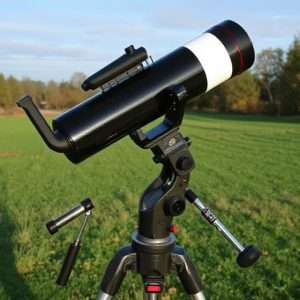
For those seeking precision in a compact form, the Sky-Watcher SkyMax 127 delivers high-contrast images in a lightweight Maksutov-Cassegrain design. Its long focal length is perfect for close-up planetary views, and it’s easy to carry and store between sessions.
What I really appreciate about this telescope is how consistently it produces crisp and detailed images. It’s particularly good for viewing the moon and planets under light-polluted skies, which makes it a solid choice for urban astronomers. Its enclosed optical tube keeps maintenance low, and the build quality feels premium.
Key Features
- 127mm aperture
- Maksutov-Cassegrain optical system
- 1500mm focal length
- Equatorial mount with slow-motion controls
- Red dot finder
Pros
- High-contrast optics
- Great for planetary detail
- Minimal maintenance
- Portable and durable
Cons
- Manual tracking may be tricky for beginners
- Limited wide-field viewing
4. Meade Infinity 102AZ

The Meade Infinity 102AZ is a refractor telescope that offers a user-friendly experience and solid optics for viewing bright planets and the Moon. It’s particularly suitable for new astronomers who want to avoid the learning curve that comes with reflectors and equatorial mounts.
From my experience, this telescope provides sharp, high-contrast views and comes with a range of eyepieces and a Barlow lens for magnification options. It’s easy to transport and set up, making it great for spontaneous observing sessions. The included slow-motion control is helpful when manually tracking celestial objects.
Key Features
- 102mm aperture
- Alt-azimuth mount with fine controls
- Comes with three eyepieces and Barlow lens
- Red dot finder
- Lightweight design
Pros
- Easy to use for beginners
- No collimation required
- Good range of included accessories
- Clear images of bright planets
Cons
- Mount could be sturdier
- Not suitable for deep-sky objects
5. Celestron AstroMaster 130EQ

The Celestron AstroMaster 130EQ is a reflector telescope that provides a balanced mix of performance and affordability. Its 5.1-inch aperture gathers enough light for detailed planetary views while remaining compact enough for easy transport.
I’ve used this scope on several occasions and found it ideal for tracking planets over long observation sessions. The German equatorial mount allows precise tracking, though it takes some time to get used to. It’s an excellent choice for those wanting to grow their skills while enjoying great planetary visuals.
Key Features
- 130mm aperture
- Newtonian reflector design
- German equatorial mount
- Two included eyepieces (10mm and 20mm)
- StarPointer red dot finder
Pros
- Strong planetary imaging capability
- Equatorial mount supports long sessions
- Expandable with better eyepieces
- Reasonably priced
Cons
- Mount setup takes practice
- Requires regular collimation
6. Explore Scientific FirstLight AR102
Explore Scientific’s FirstLight AR102 is another solid refractor telescope ideal for planetary and lunar observation. With a wide field of view and excellent contrast, this telescope brings out details in planets and makes a great companion for astronomers who value image clarity.
What stood out for me was the quality of the lens and the robustness of the mount. It’s easy to handle and doesn’t need much upkeep, which is a relief if you’re frequently on the move. I’ve found it great for quick setups during impromptu stargazing sessions.
Key Features
- 102mm aperture
- Achromatic refractor optics
- Multiple mounting options
- Includes eyepiece and finder scope
- Two-speed rack and pinion focuser
Pros
- Excellent optical quality
- Low maintenance needs
- Durable construction
- Ideal for bright planet viewing
Cons
- Some chromatic aberration
- Slightly heavier than entry-level scopes
Frequently Asked Questions
What type of telescope is best for viewing planets?
The best telescopes for viewing planets are typically refractor or compound telescopes with long focal lengths and stable mounts. Refractors produce sharp, high-contrast images of Jupiter, Saturn, and Mars, while compound telescopes like the Schmidt-Cassegrain offer a mix of portability and power.
Modern smart telescopes are also becoming popular among beginners because they automatically locate planets and adjust focus, making planetary observation effortless. When choosing one, focus on optical quality and ease of use rather than just technical specs — a key reason to buy and avoid specifications that don’t enhance real-world performance.
What telescope do I need to see Saturn’s rings?
To see Saturn’s rings clearly, you’ll need at least a 90mm refractor or a 130mm reflector telescope. These sizes reveal not just the rings but also subtle details like Cassini’s Division and Saturn’s largest moon, Titan.
An 8-inch Dobsonian, one of the best telescopes for viewing planets, provides stunning, high-quality views with impressive contrast. Many smart telescopes also track Saturn automatically, allowing beginners to capture crisp, detailed planetary images without complex setup.
Is 50x and 100x good for a telescope?
Yes — 50x to 100x magnification is excellent for observing planets like Jupiter and Saturn. At 50x, you can easily see the planets’ shapes and moons, while 100x lets you view surface details and ring structures.
However, image quality depends more on optics than on magnification numbers. That’s why many astronomers emphasize buy reasons to avoid specifications that sound impressive but don’t translate into better performance. A high-quality telescope for planetary imaging at 100x often outperforms a cheap one advertised at 400x.
What magnification telescope do I need to see planets?
For planetary viewing, 100x to 250x is ideal. Jupiter’s cloud bands, Saturn’s rings, and Mars’ polar caps appear crisp at these levels with good optics.
Rather than chasing high magnification numbers, focus on lens quality, mirror alignment, and mount stability — these are the real reasons to buy a telescope that performs well under real sky conditions.
Can I see planets with a 70mm telescope?
Yes, a 70mm telescope can reveal Saturn’s rings, Jupiter’s four moons, and Mars as a small orange disk. It’s one of the best entry points for beginners exploring planetary observation.
While you won’t get the same clarity as with a high-quality telescope for planetary imaging, a 70mm refractor remains a solid, budget-friendly choice to start your stargazing journey.
What size telescope to see planets for beginners?
For beginners, a 70mm to 130mm telescope is ideal. This range provides clear, bright views of the Moon and all major planets without being too heavy or expensive.
A smart telescope within this size range can automatically find and track planets, making the experience even easier. When comparing models, remember the reasons to buy and avoid specifications that focus only on magnification instead of optical performance.
Should a beginner get a refractor or reflector telescope?
Both designs have pros and cons. Refractor telescopes are low-maintenance and great for crisp, high-contrast views of planets. Reflector telescopes, like Dobsonians, offer larger apertures at a lower cost — perfect for deep-sky and planetary observing.
For convenience and automation, many beginners prefer smart telescopes, which combine digital guidance with quality optics. Your reasons to buy should prioritize usability, portability, and clear planetary detail — not just brand specs.
How much do good planet-viewing telescopes cost?
A good telescope for viewing planets typically costs between $250 and $800. Entry-level models like a 70mm refractor offer sharp planetary views, while 8-inch Dobsonian or smart telescopes in the higher range deliver professional-level clarity and stability.
Always weigh reasons to buy vs. avoid specifications that exaggerate magnification or features. A high-quality telescope for planetary imaging doesn’t need to be the most expensive — it just needs solid optics and a steady mount.
Is 50mm or 70mm better for a telescope?
A 70mm telescope is significantly better for planetary viewing than a 50mm one. The larger aperture gathers more light, allowing you to see finer details on Jupiter, Saturn, and the Moon.
While 50mm scopes are portable and affordable, they’re best for beginners exploring the night sky casually. For anyone serious about observing planets, the best telescopes for viewing planets start at 70mm and above, offering sharper images and better color contrast.
Conclusion
Choosing the best telescopes for viewing planets depends on your experience level, observing conditions, and personal preferences. For tech enthusiasts, the Celestron NexStar 6SE offers a smart, automated solution. For purists who want excellent optics with minimal tech, the Orion SkyQuest XT8 is a powerhouse.
From compact Maksutovs to versatile reflectors and easy-to-use refractors, each model on this list brings its own advantages to the table. No matter which one you pick, what’s most important is that it encourages you to spend more time under the stars, exploring the wonders of our solar system in detail.