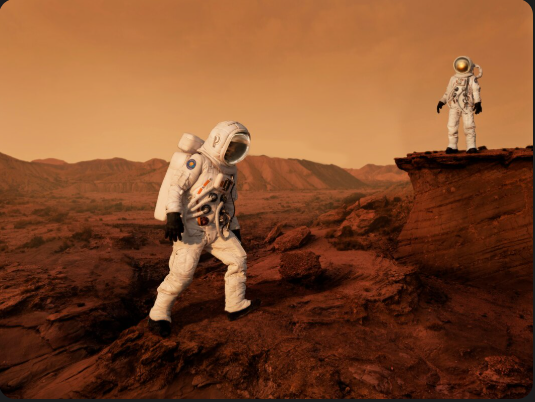
Living on Mars: How Close Are Humans to Colonizing the Red Planet?
If you’ve ever looked up at that small red dot glowing in the night sky and wondered if people will ever live there, you’re not alone. The dream of living on Mars has captured humanity’s imagination for generations.
The question is no longer if it will happen, it’s when.
So, can humans live on Mars? The short answer: Not yet, but we’re getting closer than ever before.
With NASA, SpaceX, and international space agencies racing to send humans to Mars within the next few decades, the idea of a Mars colony is shifting from science fiction to an achievable reality. The journey won’t be easy, but the roadmap is unfolding right before our eyes.
Let’s explore what living on Mars might look like, the science behind colonization, and the challenges we’ll need to overcome to call another planet home.
Why Mars?
Out of all the planets in our solar system, Mars is the most Earth-like. It has mountains, valleys, seasons, and polar ice caps. A day on Mars lasts about 24.6 hours, and its tilt creates weather patterns similar to Earth’s.
Yet, it’s also a world of extremes, freezing temperatures, thin air, and fierce dust storms.
So why Mars, and not the Moon or Venus?
Because Mars is just close enough to reach and just similar enough to imagine living there. It’s the best candidate for a second home for humanity, a place where we could survive, thrive, and ensure our species endures beyond Earth.
The Journey There: How Long Would It Take?
Before anyone starts planting flags or building domes, the first challenge is simply getting there.
The distance between Earth and Mars varies as the two planets orbit the Sun, but on average, it’s about 225 million kilometers (140 million miles).
Using current rocket technology, it would take between 6 to 9 months to reach Mars, depending on the mission’s trajectory.
Future propulsion systems, such as nuclear thermal rockets and ion drives, might cut that time significantly, but we’re still years away from deploying them at scale.
The journey itself poses enormous risks, including:
Radiation exposure from cosmic rays
Psychological stress from isolation
Limited resources for emergencies
Still, every major space agency, and private companies like SpaceX, is developing technologies to make the trip safer and faster.
Who’s Leading the Race to Mars?
NASA: The Steady Pioneer
NASA’s Artemis Program aims to establish a sustainable presence on the Moon as a stepping stone to Mars. By the 2030s, NASA plans a human mission to Mars, focusing on exploration rather than permanent settlement at first.
Its goals include testing life-support systems, habitats, and power sources that could later support long-term colonization.
SpaceX: The Bold Vision
Elon Musk’s SpaceX has set perhaps the most ambitious goal: to build a self-sustaining city on Mars.
SpaceX’s Starship spacecraft, a fully reusable rocket, is designed to carry 100 people per launch and deliver up to 100 tons of cargo to the Martian surface.
Musk’s ultimate vision is to send a million people to Mars by 2050, turning it into a thriving colony.
While that timeline is optimistic, SpaceX has already made major progress in reusable rockets, orbital tests, and life-support planning.
International Efforts
ESA (European Space Agency) and JAXA (Japan) are collaborating on future Mars sample-return missions.
China’s CNSA has successfully landed the Zhurong rover and plans to send humans by the late 2030s.
UAE’s Mars 2117 program envisions a small, functional Mars city by, you guessed it, the year 2117.
The race is global, and collaboration may be what finally gets us there.
What Would Living on Mars Be Like?

Imagine waking up on Mars. The light filtering through your habitat dome is pinkish-orange, and outside, the landscape stretches endlessly, rocky, dusty, and beautiful in its stillness.
A typical Martian day, called a sol, lasts just over 24 hours. That rhythm would feel familiar, but almost everything else would be foreign.
The Atmosphere
Mars’ atmosphere is 95% carbon dioxide, with almost no oxygen or pressure to breathe. You’d need to live inside pressurized habitats and wear a suit to step outside.
The Temperature
Average temperatures hover around −80°F (−60°C), dropping to −195°F (−125°C) at night. Heating systems powered by nuclear or solar energy would be vital.
Gravity
Mars’ gravity is 38% of Earth’s, which could affect muscle and bone health over time. Exercise and diet would become part of daily survival routines.
Food and Water
Early settlers would rely on hydroponic farming to grow crops indoors using recycled water and artificial light. Experiments on the International Space Station have already proven that lettuce, potatoes, and algae can grow in low-gravity environments.
NASA’s simulations on Earth, like the HI-SEAS habitat in Hawaii, have shown that with creativity, teamwork, and discipline, humans can adapt to living in isolated environments much like Mars.
The Challenges of Living on Mars
Building a home on another planet is more than engineering, it’s endurance.
Here are the biggest challenges of living on Mars:
Radiation Exposure: Mars lacks a strong magnetic field, leaving its surface exposed to cosmic rays. Long-term exposure can cause cancer and organ damage.
Air Pressure: The air is so thin that unprotected humans would lose consciousness within seconds.
Dust Storms: Mars’ planet-wide dust storms can last for months, blocking sunlight and damaging equipment.
Resource Scarcity: Everything from water to metals must be extracted locally or shipped from Earth, at enormous cost.
Mental Health: Isolation, confined spaces, and distance from Earth will challenge human psychology like never before.
Each of these issues has partial solutions, but none are easy.
Building a Mars Base: The First Step Toward a Colony
Before cities, there will be outposts.
NASA envisions modular bases, built from materials either brought from Earth or extracted locally (a process known as in-situ resource utilization).
A typical Mars base plan might include:
Inflatable or 3D-printed habitats made from Martian regolith
Greenhouses for food and oxygen
Underground shelters to block radiation
Solar and nuclear power stations
Rovers and drones for exploration
SpaceX has proposed using Starships themselves as the first living quarters, each converted into a temporary habitat upon landing.
Over time, permanent structures could grow around them, forming the foundations of the first Mars colony.
The Technology Making Mars Living Possible
Every new breakthrough brings Mars closer to reality.
Life Support Systems
Modern systems recycle water, air, and waste. NASA’s Environmental Control and Life Support System (ECLSS) already works on the ISS and could be adapted for Mars.
Power Sources
Solar power works well on Mars but is limited by dust storms. Small modular nuclear reactors, like NASA’s Kilopower project, may provide steady electricity for colonies.
Oxygen Production
The MOXIE experiment aboard Perseverance has successfully produced oxygen from Mars’ CO₂-rich atmosphere. Scaled up, this could supply breathable air and rocket fuel.
3D Printing
Using local soil to 3D-print shelters could eliminate the need to carry building materials from Earth. Companies like ICON and AI SpaceFactory are already testing Martian-like materials for this purpose.
Communication
Mars is so far from Earth that signals take 5 to 20 minutes each way. Future colonies will need AI-assisted systems and autonomous robots to operate independently.
Mars Colonization and the Role of SpaceX

Elon Musk’s vision for SpaceX Mars colonization is nothing short of epic.
He imagines fleets of Starships leaving Earth every 26 months, the period when the planets align most favorably. Each ship would carry equipment, supplies, and eventually settlers.
The first wave would focus on survival: power generation, water extraction, and food production.
The second wave would build infrastructure: habitats, transport systems, and communication networks.
And finally, the goal would be self-sufficiency, a colony that could grow its own food, make its own air, and mine its own fuel.
“If we can make life multiplanetary,” Musk says, “we ensure the survival of consciousness as we know it.” — Elon Musk, SpaceX CEO
While the timeline of humans living on Mars by 2050 remains ambitious, the technology under development makes it more conceivable than ever.
How Long Until People Are Living on Mars?
NASA’s cautious estimate is the late 2030s for the first crewed landing.
SpaceX aims for as early as 2030 for cargo and mid-2030s for human missions.
Realistically, large-scale colonization will take decades.
Early missions will be dangerous and experimental, similar to the early days of Antarctic exploration. But with every mission, we’ll learn more, build more, and get better at surviving on a hostile world.
Could Mars Ever Be Like Earth? The Terraforming Question
Terraforming Mars, turning it into a warm, breathable planet, sounds like the ultimate dream.
In theory, we could release greenhouse gases to warm the atmosphere, melt the ice caps, and restart a water cycle. Over centuries, oxygen-producing plants or engineered microbes could make the air breathable.
But there’s a problem: there isn’t enough CO₂ or nitrogen left on Mars to create a thick atmosphere naturally.
Current research suggests large-scale terraforming isn’t feasible with today’s technology. However, localized terraforming, such as enclosed biodomes or climate-controlled habitats, is realistic and already being tested in simulations on Earth.
Life in a Mars Colony: A Day in the Future
So what would a normal day look like for people living on Mars?
Imagine waking up inside a geodesic dome. Outside your window, a thin sun rises over red dunes. Inside, the air smells faintly metallic, recycled but fresh.
Breakfast might be made of hydroponic vegetables and lab-grown protein. Your workday could involve maintaining life-support systems, studying geology, or helping build new habitats.
Communication with Earth is delayed, so colonists rely heavily on AI and automation. Evenings might be spent under an artificial “sky,” sharing stories and music from home.
It’s life on the edge of the possible, isolated, disciplined, and filled with purpose.
Life on Mars — Facts, Challenges, and Goals
| Category | Current Facts | Future Goals |
|---|---|---|
| Distance from Earth | 225 million km (average) | Faster propulsion (3–4 month trips) |
| Travel Time | 6–9 months (current) | 3 months (advanced propulsion) |
| Surface Temperature | −80°F (−60°C) average | Heated habitats |
| Atmosphere | 95% CO₂, 0.13% O₂ | Artificial oxygen production |
| Gravity | 0.38g | Long-term adaptation & exercise regimens |
| Radiation | High exposure risk | Underground bases, shielding tech |
| Power Source | Solar panels & nuclear backup | Kilopower nuclear systems |
| Water Supply | Polar ice & subsurface deposits | Extraction and recycling systems |
| Population | 0 | 100–1,000 (by 2050, projected) |
The Psychological Side of Living on Mars
Beyond the physical challenges, the mental strain of life on Mars might be the hardest obstacle.
Isolation: No quick calls or video chats with Earth; the delay can be up to 20 minutes each way.
Confinement: Living in small spaces with a few people for years at a time.
Monotony: The same environment, the same routine, and no open sky.
NASA’s simulations, like HI-SEAS in Hawaii and Concordia Station in Antarctica, show that teamwork, humor, and routine are key to staying sane.
Future Mars settlers will need to be explorers, scientists, and psychologists all at once.
The Ethical Question: Should We Colonize Mars?
Before we plant our flags, some scientists urge caution.
What if microbial life still exists on Mars? Should we risk contaminating it with Earth organisms?
NASA’s Planetary Protection Protocols ensure that all spacecraft are sterilized to prevent biological contamination. But if humans go, contamination becomes inevitable.
The ethical debate is deep: Do we have the right to alter another planet, or does exploration come with responsibility as stewards of the universe?
Why Colonizing Mars Matters for Humanity
Even with all the risks and questions, the reason we keep looking toward Mars is simple: it represents hope.
Living on Mars isn’t just about survival, it’s about evolution. It’s about ensuring that humanity endures if Earth ever becomes uninhabitable.
It’s also about curiosity. Every rover and mission reflects our desire to explore, to learn, and to push beyond limits.
Mars teaches us humility, a reminder of how fragile and remarkable life is, wherever it may exist.
Final Thought
The dream of humans living on Mars once sounded impossible. Today, it feels inevitable.
We’ve already walked the Moon, built homes in orbit, and touched the surface of Mars with our robots. The next step, setting foot there ourselves, is within reach.
Living on Mars will challenge everything we know about science, engineering, and human endurance. But it will also redefine what it means to be a citizen of the universe.
So when you look up at that small red light tonight, remember, it’s more than a planet. It’s a promise. A reminder that our story has only just begun, and Mars might be the next chapter we write among the stars.


