Schmidt-Cassegrain Telescope: Exploring Its Features and Advantages
As someone who has explored various telescopic designs over the years, I find the Schmidt-Cassegrain telescope to be a fascinating blend of innovation and practicality. It’s a popular choice for astronomers, both novice and seasoned, due to its combination of portability, high performance, and versatility. If you’re considering adding a telescope to your collection or upgrading your current setup, you might be wondering, “What makes the Schmidt-Cassegrain telescope stand out?” In this article, I’ll walk you through everything I’ve learned about this incredible optical instrument, from its design to its benefits and challenges.
Understanding the Schmidt-Cassegrain Telescope

The Schmidt-Cassegrain telescope is part of a family of catadioptric telescopes, which means it incorporates both lenses and mirrors to form images. It uses a spherical primary mirror, a secondary mirror, and a corrector plate, which is a curved lens located at the front of the telescope. The corrector plate helps eliminate optical aberrations that can distort the image. This telescope design was created to provide the best of both worlds: the sharpness of a refractor and the light-gathering power of a reflector.
One of the main advantages of this design is its ability to maintain a long focal length while keeping the physical length of the telescope relatively short. This makes it more compact than other telescopes with similar focal lengths, which is a huge advantage for stargazers who need a portable telescope.
How the Schmidt-Cassegrain Telescope Works
The optical design of the Schmidt-Cassegrain telescope is what truly sets it apart. Light enters through the corrector plate, travels toward the primary mirror, and then reflects back to the secondary mirror. The secondary mirror redirects the light toward a hole in the primary mirror and through the eyepiece or camera. This method allows the telescope to capture a large amount of light and produce bright, clear images.
What I love most about this telescope is its versatility. Whether you’re into observing planets, studying the moon, or capturing distant galaxies, the Schmidt-Cassegrain telescope is up to the task. The combination of light-gathering ability, high magnification, and sharpness makes it an excellent all-around choice for a wide range of astronomical observations.
The Benefits of Using a Schmidt-Cassegrain Telescope

There’s no shortage of advantages when it comes to using a Schmidt-Cassegrain telescope. As someone who has used various types of telescopes, I’ve found this design to offer numerous benefits for stargazing, astrophotography, and general astronomy. Below are the key benefits I’ve experienced firsthand:
Compact and Easy to Transport
One of the most appealing features of the Schmidt-Cassegrain telescope is its compact design. Despite its long focal length, it has a relatively short physical length compared to other telescopes of similar capability. This compactness makes it far more portable, which I’ve found extremely convenient when traveling to darker skies for optimal stargazing. Whether I’m driving to a remote location or simply transporting it from one room to another, this telescope is lightweight and easy to manage.
High Light-Gathering Power
The Schmidt-Cassegrain telescope excels at gathering light. Its large primary mirror allows it to collect more light than smaller telescopes, which is crucial for observing faint objects like galaxies, nebulae, and distant stars. The added light-gathering capability means that the telescope can provide clear, bright views of deep-sky objects. I’ve used this feature extensively in astrophotography, where capturing faint details is essential. It has consistently delivered outstanding results.
Versatility for Different Types of Observations

Whether I’m observing the planets, looking at the moon’s surface, or photographing distant galaxies, the Schmidt-Cassegrain telescope’s versatility makes it an ideal choice. It can handle high magnifications for detailed views of planetary surfaces and the lunar landscape. At the same time, its powerful light-gathering ability is perfect for deep-sky observation. I’ve enjoyed using it for a variety of tasks, from casual stargazing to more serious astrophotography, and it consistently delivers.
Minimal Optical Distortions
The corrector plate of the Schmidt-Cassegrain telescope plays a significant role in ensuring that images are sharp and free of optical distortions. Unlike simple reflectors that may suffer from spherical aberration (blurry images), the corrector plate corrects these issues and provides clearer, sharper images. This is especially beneficial for anyone who’s interested in astrophotography, where image clarity is key. Over time, I’ve found that the Schmidt-Cassegrain telescope delivers exceptional image quality without the optical issues that can arise with other designs.
Challenges of the Schmidt-Cassegrain Telescope
While the Schmidt-Cassegrain telescope has numerous advantages, it’s important to acknowledge that there are also some challenges that come with using it. Having used this telescope for a while, I’ve come to recognize both its strengths and areas that may require a bit more attention.
Higher Price Point
One of the main drawbacks of the Schmidt-Cassegrain telescope is its price. Due to its advanced optics and construction, it’s generally more expensive than other telescope types, like simple refractors or reflectors. For beginners, the cost can be a significant factor. However, in my experience, the quality of the telescope and its ability to deliver exceptional results makes it worth the investment for serious astronomers. If you’re willing to pay for top-notch performance, the Schmidt-Cassegrain telescope is an excellent choice.
Cooling Down Period
Another challenge with this telescope is that it can take some time to cool down after being taken outside. The large mirror needs to adjust to the outdoor temperature before it can provide optimal performance. Until this happens, you may notice some distortion in the images, especially if you’re observing faint objects or engaging in astrophotography. I’ve learned to be patient and allow the telescope time to cool down, but it’s something to keep in mind if you plan to start observing immediately after setting it up.
Maintenance and Care
Like all telescopes, the Schmidt-Cassegrain requires some level of maintenance. The mirrors can occasionally fall out of alignment, which may require collimation to ensure the telescope works properly. Additionally, the corrector plate can accumulate dust and debris over time, which may affect image quality. While these maintenance tasks aren’t particularly difficult, they are essential for keeping the telescope in top condition. It’s something I’ve become accustomed to, but beginners may need a bit of guidance when it comes to proper care and maintenance.
Frequently Asked Questions
What is a Schmidt-Cassegrain telescope good for?
A Schmidt-Cassegrain telescope (SCT) is known for its versatility and compact design, making it one of the best all-around telescopes for both planetary and deep-sky observation.
Thanks to its long focal length, an SCT provides sharp, detailed views of planets, the Moon, and star clusters, while its wide aperture gathers enough light for faint galaxies and nebulae. It’s also excellent for astrophotography, especially when paired with tracking mounts or camera adapters. Many astronomers consider the Schmidt-Cassegrain to be the best telescope type for viewing planets and imaging the night sky.
What are the disadvantages of the Schmidt-Cassegrain telescope?
While highly capable, Schmidt-Cassegrain telescopes do have a few drawbacks:
⚙️ Higher cost: They are generally more expensive than reflectors or refractors of similar size.
🔧 Collimation required: The mirrors occasionally need alignment for optimal image quality.
🌡️ Cool-down time: The closed-tube design takes longer to adjust to outdoor temperatures.
🔭 Narrow field of view: SCTs excel at zoomed-in planetary and lunar views but are less ideal for wide-field deep-sky sweeps.
Despite these limitations, their optical power and portability make them a top choice for dedicated observers and astrophotographers alike.
Is a Cassegrain telescope good for beginners?
Yes — a Cassegrain telescope can be good for beginners who want a long-term, high-quality investment in astronomy. The compact size, motorized mounts, and GoTo features found in many modern SCTs make them user-friendly despite their advanced optics.
However, absolute beginners may prefer simpler refractors or Dobsonians first. A Cassegrain telescope for beginners becomes ideal once you’re ready to explore detailed planetary viewing or start basic astrophotography.
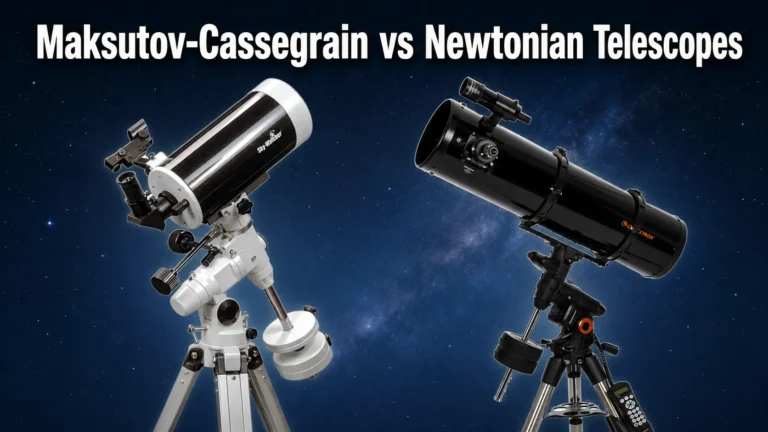
Is Schmidt-Cassegrain better than Newtonian?
Both telescope types have distinct advantages. A Schmidt-Cassegrain telescope offers a compact, portable design with long focal length and high magnification — perfect for planetary viewing and imaging. A Newtonian telescope, on the other hand, provides larger apertures at a lower cost, making it better for deep-sky observation like nebulae and galaxies.
If your main interest is high-quality telescope performance for planetary imaging, the Schmidt-Cassegrain typically delivers sharper, more contrast-rich results. But for beginners or budget-conscious stargazers, a Newtonian reflector gives exceptional value and brightness per dollar.
Conclusion
In my experience, the Schmidt-Cassegrain telescope is a fantastic option for anyone looking for a versatile, high-performance telescope. Its compact design, light-gathering ability, and sharp image quality make it an excellent choice for both visual stargazing and astrophotography. While it comes with a higher price tag and requires some maintenance, the benefits far outweigh these challenges for those who are serious about astronomy.
If you’re an amateur astronomer looking to upgrade your equipment, or if you’re seeking a telescope that can handle a wide range of observations, the Schmidt-Cassegrain telescope is an investment you won’t regret. Its combination of portability, performance, and versatility make it one of the best telescopes on the market today. Whether you’re exploring the planets, capturing stunning astrophotography, or observing deep-sky objects, the Schmidt-Cassegrain telescope is sure to enhance your astronomical experience.