Where Do Astronomers Work: Exploring the Diverse Careers of Stargazers
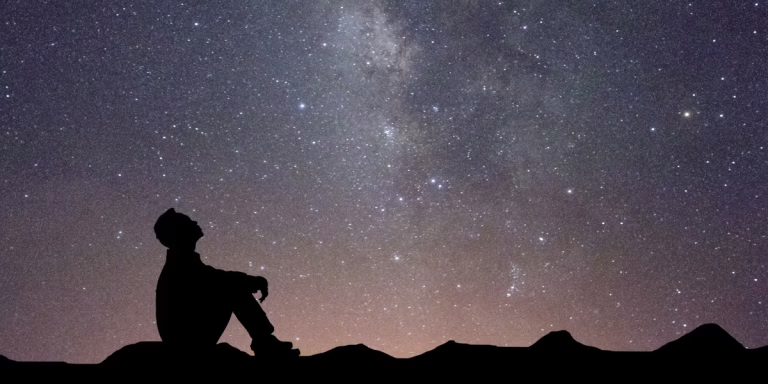
When I first started diving into the world of astronomy, I used to picture astronomers as lone figures perched atop remote mountaintops, hunched over massive telescopes beneath starry skies. While that romantic image holds some truth, the real answer to where do astronomers work is far more complex and fascinating. Over time, I’ve come to appreciate the wide variety of places, environments, and roles astronomers occupy—and not all of them involve peering into an eyepiece at midnight.
Let me walk you through the many landscapes of modern astronomy, from buzzing universities to quiet data labs, and even into corporate offices. Whether it’s observing the cosmos, developing space technologies, or teaching future scientists, astronomers are doing important work all around the globe—and even beyond it.
Academic Institutions: Where Science and Curiosity Meet
The Foundation of Astronomical Research

A large number of astronomers work in universities, and that’s where I first encountered professional astronomers myself. These institutions are not just places of learning; they’re engines of scientific progress. When people ask me where do astronomers work, I often begin with this answer because academia is where many astronomical careers begin and thrive.
Astronomers at universities typically split their time between teaching and research. Some teach undergraduate physics or astronomy classes, while others supervise graduate students working on niche areas like cosmology, stellar evolution, or planetary science. Their research might involve theoretical modeling, software development, or data analysis from satellite missions. The university setting provides flexibility and resources—like high-speed computing labs and telescope time—so astronomers can dive deep into their work while mentoring the next generation.
Collaborations and Innovation
What many people don’t realize is that astronomers at universities often collaborate internationally. I once met an astronomer who co-authored a paper with scientists from five different countries, all while based at a local college. This kind of teamwork helps expand the boundaries of what we know, especially when tackling universal mysteries like dark matter or exoplanet detection.
Government Agencies and Space Exploration Organizations
NASA, ESA, and Beyond

Another significant workplace for astronomers is within government-funded space agencies. If you’ve ever wondered where do astronomers work when it comes to missions like the Hubble Space Telescope or the Mars rovers, the answer lies with agencies like NASA (United States), ESA (Europe), JAXA (Japan), and ISRO (India).
These agencies employ astronomers in various capacities—from mission design and operations to instrument calibration and long-term data analysis. One astronomer I read about spent years preparing sensors for the James Webb Space Telescope, while another focused solely on analyzing radiation signatures from distant quasars using NASA’s Chandra X-ray Observatory.
The Power of Applied Astronomy
What excites me most about this field is how astronomers in these agencies contribute directly to humanity’s exploration of space. Their findings don’t just sit in scientific journals—they inform real missions, from plotting safe satellite orbits to predicting cosmic hazards like solar flares and asteroid flybys.
Observatories: The Traditional Domain of Stargazers
Ground-Based Observing
When you picture an astronomer at work, you might imagine them at a giant telescope, and in many cases, you’d be right. Observatories, particularly those situated in remote and high-altitude locations, are still vital to astronomical research. I once had the chance to tour an observatory in the Chilean Andes. The scientists there worked long nights capturing light from distant galaxies, then spent their days analyzing the results, troubleshooting instruments, and preparing for the next observation cycle.
Observatories vary widely in size and focus. Some are public institutions tied to universities, while others are privately funded or operated by government agencies. Many astronomers apply for “telescope time,” a competitive process where researchers must justify why their project deserves access to the observatory’s resources.
Robotic and Remote Observing
Today, not all astronomers need to travel to mountaintops. With the development of robotic telescopes and advanced remote systems, scientists can now operate telescopes from thousands of miles away—sometimes from the comfort of their own offices. These setups not only save time and travel but also allow round-the-clock monitoring, which is crucial for studying transient phenomena like supernovae or gamma-ray bursts.
Planetariums and Science Outreach Centers
Making the Cosmos Accessible

Another unexpected but equally important answer to where do astronomers work is: in planetariums and public science centers. These professionals often serve as the face of astronomy, helping everyday people understand the night sky. They create and host shows about celestial events, run workshops for kids, and explain the latest discoveries to the public in clear, engaging ways.
I’ll never forget visiting a local science center where an astronomer used a digital sky dome to simulate the night sky in real time. He showed us constellations, the phases of the moon, and how the planets move over days and months. That experience ignited the curiosity that eventually led me to study astronomy more seriously.
Education Through Entertainment
Astronomers working in outreach roles often collaborate with educators and media specialists to develop planetarium shows, YouTube series, or public lectures. Their goal is not just to inform but to inspire—a job I find especially rewarding in a world increasingly dominated by screens and distractions.
The Private Sector: Space Beyond the Public Domain
Commercial Aerospace and Data Analysis

With the rise of private space ventures like SpaceX, Blue Origin, and Rocket Lab, astronomers are finding new opportunities outside traditional institutions. I was fascinated to learn how many astronomers now contribute to designing satellite systems, building imaging technologies, and even planning space tourism missions.
Astronomers’ skills in analyzing large datasets also make them valuable in industries far removed from space science. I’ve come across astronomers working in finance, climate science, and artificial intelligence because their experience with modeling complex systems transfers well into those fields.
Startups and Tech Companies
Startups focused on Earth observation or asteroid mining are also hiring astronomers to refine their optics, manage orbital logistics, or interpret space-based data. The versatility of an astronomy background means these scientists can shape the future of technology, both in space and on Earth.
Working from Anywhere: The Age of Digital Astronomy
Cloud Computing and Virtual Observatories
Thanks to cloud computing, remote collaboration, and vast online databases, it’s now possible for astronomers to work entirely from digital platforms. That means when you ask where do astronomers work, the answer might literally be: anywhere with an internet connection.
Astronomers today have access to publicly available datasets from missions like Gaia, Kepler, and TESS. Some astronomers never touch a telescope at all—they analyze petabytes of celestial data using Python scripts or machine learning models.
Flexibility and Accessibility
This digital transformation has opened the door to amateur astronomers, part-time researchers, and students across the globe. As someone who once believed astronomy was only for people with advanced degrees and access to observatories, I find this democratization of science incredibly encouraging.
Conclusion
So, where do astronomers work? The answer spans observatories nestled in mountains, bustling university campuses, cutting-edge space agencies, dynamic startups, and even living rooms. From teaching and public outreach to exploring deep space through powerful instruments, astronomers are working hard to unlock the secrets of the universe—and they’re doing it in more places than ever before.
As someone who once looked up at the stars with a sense of distant wonder, I now realize the vast range of opportunities within this field. Whether it’s analyzing satellite data or inspiring a room full of curious students, astronomers are out there, working tirelessly to deepen our understanding of the cosmos. Their work may be spread across the Earth, but their focus always remains on the stars.