
How to Choose a Telescope: The Ultimate Beginner’s Guide to Finding the Perfect Scope
I still remember the day I decided I wanted a telescope. I had spent countless nights lying under the stars, wondering what planets or galaxies were hiding just beyond my vision. But as soon as I began searching for my first telescope, I realized I was wading into deep waters. The terminology was unfamiliar, the options were endless, and the prices varied wildly. So, if you’re like me and wondering how to choose a telescope, let me walk you through what I’ve learned through experience—mistakes and all.
Understanding What You Want from a Telescope
Define Your Stargazing Goals
When I first started, I thought all telescopes were the same. I just assumed you pointed it at the sky, and suddenly Saturn’s rings or distant galaxies would be visible. Not quite. One of the most helpful things I did was sit down and figure out what I actually wanted to observe. Were planets my priority? Or was I more fascinated by faint star clusters and nebulae?
If you’re interested in high-contrast views of the Moon or the planets, you’ll want a telescope with high focal length and clear optics. On the other hand, if you’re more drawn to the subtle glows of deep-space objects, you’ll need a telescope with a wide aperture to collect as much light as possible.
Think About Where and How You’ll Be Using It
My first telescope was so large and heavy that taking it outside became a chore. I quickly realized I needed something more manageable. If you’re planning to observe from your backyard or a dark-sky site a few miles away, portability matters. Telescopes come in all shapes and sizes—some ideal for home use and others built for easy transportation. Figuring this out early can save you frustration later.
Breaking Down the Main Types of Telescopes

Refractor Telescopes
These were the ones I was most familiar with growing up—the long, tube-like scopes that use lenses to focus light. Refractors are great for beginners because they require minimal maintenance and provide crisp views of the Moon and planets. My first telescope was a small refractor that I used for backyard viewing. The image quality was great for its size, and it didn’t need frequent adjustments.
Reflector Telescopes
Reflectors use mirrors instead of lenses to gather and focus light. Newtonian reflectors are the most common type you’ll see for amateur astronomers. They typically offer a larger aperture for the price, which means better performance for deep-sky observing. I eventually upgraded to a 6-inch reflector, and it completely transformed my viewing experience. However, I also had to learn how to align the mirrors properly—what’s known as collimation—which was a bit intimidating at first but became easier over time.
Catadioptric or Compound Telescopes
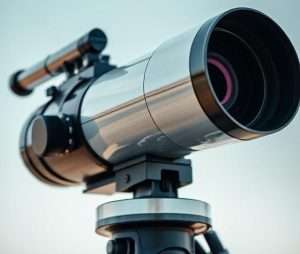
This type of telescope combines mirrors and lenses, giving you the best of both worlds in a compact design. Schmidt-Cassegrain and Maksutov-Cassegrain models fall under this category. They tend to be more expensive but are versatile and easier to transport. After using both refractors and reflectors, I eventually invested in a compound telescope. Its compact design and long focal length made it great for everything from lunar observation to astrophotography.
Demystifying Telescope Specs
Aperture: Your Most Important Consideration
The aperture is the diameter of the main mirror or lens, and it dictates how much light the telescope can collect. A larger aperture allows you to see fainter objects and finer details. If there’s one thing you take away from learning how to choose a telescope, let it be this: aperture matters more than magnification. My 80mm refractor gave decent planetary views, but I couldn’t really explore deep-space objects until I upgraded to a larger scope.
Focal Length and Focal Ratio
The focal length is the distance the light travels inside the telescope before reaching your eye. A longer focal length typically means higher magnification, which is great for planetary detail. But there’s a trade-off—long focal lengths often narrow your field of view. The focal ratio (f/number) is the focal length divided by the aperture. A lower number (like f/5) means a wider view, which is great for deep-sky observation. A higher number (like f/10) gives better detail but a narrower field.
Magnification Myths
When I started out, I got caught up in the idea that higher magnification was always better. It’s not. The maximum useful magnification of a telescope is about 50 times the aperture in inches. Anything more than that, and the image will just be a blurry mess. You’re better off with a well-matched eyepiece and good optics than chasing sky-high magnification numbers.
Mounts Are Just as Important
Alt-Azimuth Mounts

My first telescope came with a basic alt-azimuth mount. It moved up and down, left and right—just like a camera tripod. This kind of mount is simple and intuitive, which makes it perfect for beginners. However, it can be tricky to follow a moving object in the sky, as you need to make constant adjustments on two axes.
Equatorial Mounts

Once I got more serious about observing, I upgraded to an equatorial mount. This type of mount aligns with Earth’s rotation, so you can follow stars and planets smoothly by adjusting just one axis. It takes some time to set up properly, but once you get the hang of it, tracking celestial objects becomes far easier—especially if you’re interested in astrophotography.
Don’t Forget the Accessories
Eyepieces and Barlow Lenses
Most beginner telescopes come with one or two eyepieces, but you’ll eventually want to expand your collection. A 25mm eyepiece is good for wide-field viewing, while a 10mm gives you more magnification. Adding a Barlow lens to your kit can double or triple the power of each eyepiece, offering more flexibility without needing to buy a whole new set.
Finders and Star Charts
I spent way too much time in my early days trying to aim the telescope at specific stars. That changed when I got a red dot finder. It allowed me to easily line up the telescope with what I wanted to see. A simple star chart or app can also make a huge difference in planning your night of observation.
Budgeting and Expectations
Telescopes come in a huge range of prices. My advice? Start modestly, learn what you like, and then upgrade. You can find a decent beginner telescope in the $200 to $400 range. Avoid the flashy models that promise ultra-high magnification for a low price—those are often disappointing. Also, consider buying used gear from a local astronomy club or online forum. That’s how I got my second scope, and it was in great condition for half the retail price.
Try Before You Buy
One of the best decisions I made was attending a local astronomy meetup. I got to try out several types of telescopes and ask questions from people with years of experience. It helped me make a confident decision and avoid wasting money on gear that didn’t suit my needs. Many clubs host star parties where newcomers are welcome—check your local area and don’t be shy.
FAQ
Is 50mm or 70mm better for a telescope?
A 70mm telescope is noticeably better than a 50mm model for both clarity and light-gathering power. The extra aperture lets you see brighter, sharper details of planets and the Moon, making it one of the best entry-level telescopes for viewing planets.
While a 50mm telescope is lightweight and portable, a 70mm refractor or reflector offers far more versatility — perfect for beginners ready to explore Saturn’s rings, Jupiter’s moons, and lunar craters in greater detail.
Which telescope is better, reflecting or refracting?
Both designs have strengths, but it depends on your goals. A refracting telescope (refractor) provides crisp, high-contrast images that are excellent for planetary viewing and require little maintenance. A reflecting telescope (reflector) offers larger apertures at lower prices, making it ideal for deep-sky objects such as galaxies and nebulae.
If your main focus is the best telescope for viewing planets, a refractor or compound telescope with a long focal length is often the best choice for steady, color-accurate views.
Which telescope is best for viewing planets?
The best telescopes for viewing planets are those with high-quality optics, steady mounts, and moderate to large apertures. Popular choices include refractors between 80mm and 120mm, 6-inch to 8-inch Dobsonian reflectors, or modern smart telescopes with automatic tracking.
For clear views of Jupiter, Saturn, and Mars, look for telescopes with strong optical coatings and a long focal length rather than just high magnification. These factors make a far bigger difference than flashy specs.
Can I see planets with a 70mm telescope?
Yes — you can absolutely see planets with a 70mm telescope. A quality 70mm refractor reveals Saturn’s rings, Jupiter’s four largest moons, Mars’ red surface, and the phases of Venus. You can even spot Uranus and Neptune as faint blue-green dots under dark skies.
A 70mm telescope is often recommended as the best beginner telescope for planets because it combines portability, affordability, and strong optical performance — everything you need to start exploring the Solar System.
Final Thoughts
If you’re just getting started and want to know how to choose a telescope, the process may feel overwhelming. But trust me, it gets easier with every step. My journey began with confusion and a bit of trial and error, but it eventually led me to a telescope that fits my lifestyle and observing interests perfectly.
Start by figuring out what you want to observe and where you’ll be observing from. Learn the differences between refractors, reflectors, and compound scopes. Understand how aperture, focal length, and mount types affect your viewing experience. Set a realistic budget, and don’t forget to explore used options or test scopes at local astronomy events.
Most importantly, don’t worry about getting the “perfect” telescope right away. The sky isn’t going anywhere, and part of the fun is learning as you go. With patience and curiosity, your first telescope can open up a universe of discovery.


