


As an avid follower of space exploration and astronomy, I have always been captivated by the beauty and complexity of Saturn, the magnificent gas giant that orbits our Sun. Its ring system has long been one of the most distinctive features of the planet, catching the eyes of astronomers and casual stargazers alike. However, recent research has uncovered a rather surprising truth: Saturn’s rings, which have been iconic for so long, are slowly disappearing. This raises an important question that has sparked interest in the scientific community—why is Saturn losing its rings?
In this article, I will explore the various factors contributing to the gradual fading of Saturn’s iconic rings. Understanding these causes not only sheds light on Saturn’s past but also offers valuable insights into the dynamic processes that govern our solar system. With observations from space missions like NASA’s Cassini, we’ve gathered new data that have helped answer some of these questions, but the mystery is far from solved. Let’s dive into the science behind why Saturn is losing its rings and what this phenomenon tells us about the future of this gas giant.
An Overview of Saturn’s Rings: What Makes Them So Unique?
Before we can answer why Saturn is losing its rings, it’s important to understand what makes them so fascinating in the first place. Saturn’s rings are composed of millions of small particles made up of ice, rock, and dust. The particles vary in size, from microscopic grains to large chunks the size of mountains. Despite their vastness, Saturn’s rings are remarkably thin, with an average thickness of about 30 feet but extending up to 175,000 miles in diameter. This immense system of rings has been a source of awe for astronomers since it was first observed through telescopes.
The rings are divided into several distinct sections, each varying in density and composition. The primary rings—A, B, and C—are the most well-known and visible. These are located closer to Saturn, while the outer rings, such as the D, E, F, and G rings, are fainter and less studied but still important in understanding the planet’s overall ring system. The beauty and complexity of these rings have made them a subject of numerous space missions, including the renowned Cassini mission, which observed Saturn and its rings in extraordinary detail over 13 years.
However, despite their grandeur, Saturn’s rings are not eternal, and recent findings have led us to ask the pressing question: why is Saturn losing its rings?
Ring Rain: The Process Behind Saturn’s Ring Loss
One of the key factors contributing to the gradual loss of Saturn’s rings is a process known as “ring rain.” Essentially, the particles that form Saturn’s rings are constantly being pulled toward the planet by its immense gravitational force. As the particles move closer to the planet, they eventually fall into Saturn’s atmosphere, where they are absorbed or vaporized. This process is ongoing and occurs on a large scale, leading to the gradual erosion of the rings.
Ring rain is largely caused by Saturn’s magnetic field, which interacts with the ice and dust particles within the rings. The particles are charged by the planet’s magnetic field, and this charge causes them to spiral inward. Over time, this constant motion draws the material into Saturn’s atmosphere. This process happens slowly, but at a significant rate, meaning that Saturn’s rings are losing material every day. NASA’s Cassini spacecraft provided invaluable data on this process, showing that Saturn loses thousands of tons of ring material every day through ring rain.
What’s even more fascinating is that scientists estimate Saturn’s rings may be gone in just 100 million years. While that might seem like an unimaginable amount of time, it’s relatively short in the lifespan of the planet itself, which is over 4 billion years old. This time scale offers a glimpse into the transient nature of celestial bodies and the ongoing changes occurring in our solar system.
The Role of Saturn’s Moons in Ring Disintegration
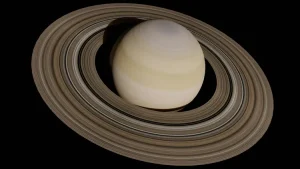
Saturn’s moons also play an essential role in the gradual loss of its rings. The planet’s moons, particularly the larger ones, have a strong gravitational influence on the particles within the rings. These moons can disturb the ring material, pulling some particles inward and creating gaps in the rings. The gravitational interactions between Saturn and its moons contribute to the destabilization of the ring system, further accelerating the rate at which Saturn loses its rings.
A prime example of this phenomenon is the moon Pan, which orbits within Saturn’s rings. Pan’s gravitational pull causes disturbances in the nearby ring particles, pushing them inward. As these particles are slowly directed toward Saturn, they contribute to the ongoing erosion of the rings. In addition to Pan, other moons, such as Mimas and Enceladus, also have a significant impact on the ring system. Mimas, for instance, helps to shape the boundaries of the A and B rings, while Enceladus’ icy jets add new material to the rings even as they continue to lose mass.
Despite these moons’ constant influence, their impact is not enough to halt the overall loss of Saturn’s rings. Instead, they help to perpetuate the process, causing the rings to shift, fade, and eventually dissipate over millions of years.
The Age and Origin of Saturn’s Rings
The question of why Saturn is losing its rings also leads us to consider the origins of these rings. Scientists believe that Saturn’s rings are relatively young in comparison to the planet itself. The current theory is that Saturn’s rings formed only about 100 million years ago, which is quite recent in the context of the planet’s 4.5 billion-year history. These rings may have formed from the remnants of a destroyed moon, a comet, or a collision between icy bodies. While we can’t be entirely sure of their exact origin, the prevailing theory suggests that Saturn’s rings were created by the destruction of a moon or celestial body that came too close to the planet and was torn apart by its gravity.
Given the fact that the rings are relatively new and are being gradually depleted, it’s clear that they won’t last forever. Saturn’s ring system is in a state of continuous flux, with material being added and lost over time. While the loss of the rings is inevitable, the process is so slow that it won’t be noticeable for millions of years. However, as we observe the ring system today, it’s apparent that it is on the brink of a dramatic change in the distant future.
Saturn’s Future Without Rings
So, what will happen to Saturn when its rings are gone? Although it’s difficult to predict with certainty, it’s likely that Saturn will continue to be a majestic and intriguing planet even without its iconic rings. The planet’s massive size, stormy atmosphere, and numerous moons will remain fascinating to astronomers. While the loss of the rings will certainly change the appearance of Saturn, it won’t diminish the planet’s grandeur.
It’s important to remember that Saturn’s rings are not a permanent feature of the planet. In fact, they are just one phase in Saturn’s long history. The loss of these rings will not affect Saturn’s position in our solar system, but it will mark the end of one of the most recognizable and beautiful features of our cosmic neighborhood.
Ongoing Research and the Future of Saturn’s Rings
To fully understand why Saturn is losing its rings, scientists continue to study the data collected by space missions like NASA’s Cassini spacecraft. Cassini’s observations have revolutionized our understanding of the dynamics of Saturn’s ring system, and its findings continue to guide future research into planetary ring systems. As we develop more advanced technologies and send more missions to explore Saturn and its moons, we will likely uncover even more details about the fate of these magnificent rings.
In conclusion, the question of why Saturn is losing its rings is part of a larger story about the evolution and change that characterize not just Saturn, but the entire solar system. The forces of ring rain, gravitational interactions with Saturn’s moons, and the planet’s magnetic field all contribute to the ongoing loss of material from the rings. As Saturn’s rings gradually fade away over the next 100 million years, we will continue to study and marvel at their beauty and complexity, forever grateful for the insights they have provided into the workings of our solar system.


