When you look at Mars through a telescope, it stands out, bright, reddish, and alone. But Mars isn’t truly alone. Hidden in its glow are two of the smallest moons in our solar system: Phobos and Deimos.
If you’ve ever wondered does Mars have moons?, the answer is yes, two tiny, irregularly shaped worlds that orbit faster than any other natural satellites known. They may look like lumpy asteroids, but they’re part of one of the most intriguing mysteries in planetary science.
Let’s meet the moons of Mars, explore how they move, what they’re made of, and why scientists believe they could hold clues to Mars’ past, and perhaps its future.
How Many Moons Does Mars Have?
Mars has two moons — Phobos and Deimos.
Unlike Earth’s large, spherical Moon, both are small, potato-shaped bodies.
They were discovered in 1877 by the American astronomer Asaph Hall, using the 26-inch refracting telescope at the U.S. Naval Observatory in Washington, D.C.
Hall named them after figures from Greek mythology: Phobos, meaning “fear,” and Deimos, meaning “panic.” According to legend, they were the twin sons of Ares (the Greek counterpart of the Roman god Mars), who followed their father into battle.
So while Earth has one big moon, Mars has two small companions that live up to their mythic names, hauntingly close, faint, and fast.
What Do the Moons of Mars Look Like?
If you saw Phobos or Deimos up close, you might not even think they were moons. They look more like asteroids, covered in craters, ridges, and grooves.
Phobos is the larger one, with a diameter of about 22 kilometers (13.7 miles).
Deimos is smaller, about 12 kilometers (7.5 miles) across.
Both moons are irregularly shaped, not round like Earth’s Moon. They don’t have enough gravity to pull themselves into a sphere. Their surfaces are coated in a fine dust layer created by constant impacts with space debris.
NASA’s Mars Reconnaissance Orbiter and Mars Express (ESA) have sent back high-resolution images showing their battered surfaces, a record of billions of years of collisions.
Phobos: The Doomed Moon
Let’s start with the inner moon, Phobos, the larger, darker, and more dramatic of the two.
Phobos orbits just 6,000 kilometers (3,700 miles) above Mars’ surface, closer than any other moon to its planet in the solar system. For comparison, the Moon orbits Earth at a distance of about 384,000 kilometers.
Because it’s so close, Phobos orbits Mars once every 7 hours and 39 minutes, meaning it rises in the west and sets in the east twice a day for observers on the Martian surface.
Phobos is also tidally locked, so it always shows the same face toward Mars, just like our Moon does with Earth.
But there’s a twist, Phobos is slowly spiraling inward, pulled by Mars’ gravity a few centimeters closer each year. Scientists predict that in 30 to 50 million years, it will either crash into Mars or break apart to form a thin ring around the planet.
That makes Phobos a doomed moon, slowly descending toward its fiery end.
Deimos: The Gentle Drifter
Deimos is the smaller and more distant of the two moons. It orbits about 23,500 kilometers (14,600 miles) from Mars, roughly four times farther than Phobos.
Because it’s farther out, Deimos takes about 30 hours to complete one orbit. Unlike Phobos, it’s moving slowly away from Mars, inching outward each year.
Deimos’ surface is smoother than Phobos’ because its craters have been partly filled by loose dust from countless small impacts. Seen through a telescope, Deimos would appear faint, about the size of a star.
It’s peaceful, quiet, and almost weightless, a fitting counterbalance to the restless Phobos.
Are Mars Moons Captured Asteroids?
This is one of the most fascinating Mars moon facts scientists have debated for decades.
Because Phobos and Deimos look so much like asteroids from the outer asteroid belt, one theory suggests they are captured asteroids that wandered too close to Mars.
Their irregular shapes, low density, and dark surfaces support this idea. Both reflect very little sunlight, much like carbonaceous chondrites, the dark, primitive rocks found in the asteroid belt between Mars and Jupiter.
However, capturing an asteroid into a stable orbit isn’t easy. It requires precise conditions that many scientists believe would have been rare for Mars.
An alternative theory suggests that Phobos and Deimos formed from debris after a massive asteroid struck Mars billions of years ago, similar to how our Moon likely formed.
In 2025, Japan’s Martian Moons eXploration (MMX) mission, led by JAXA, will attempt to land on Phobos, collect samples, and bring them back to Earth. The results could finally answer whether the moons of Mars were captured visitors or born from Martian dust.
Mars Moon Size Comparison
| Feature | Phobos | Deimos | Earth’s Moon (for comparison) |
|---|---|---|---|
| Mean Diameter | 22.4 km | 12.4 km | 3,474 km |
| Orbit Distance from Mars | 6,000 km | 23,500 km | 384,400 km (from Earth) |
| Orbital Period | 7.6 hours | 30.3 hours | 27.3 days |
| Surface Gravity | 0.0057 m/s² | 0.003 m/s² | 1.62 m/s² |
| Escape Velocity | 11 m/s | 5.6 m/s | 2,380 m/s |
| Fate | Spiraling inward | Drifting outward | Stable |
How Far Are Mars Moons From Each Other?
Even though both moons orbit the same planet, they’re very far apart relative to their size.
At their closest, Phobos and Deimos are separated by about 17,500 kilometers (10,870 miles).
Phobos zips around Mars several times while Deimos drifts lazily in the distance. From Deimos, Mars would appear enormous, about 1,000 times larger than our Moon looks from Earth. From Phobos, Mars would dominate the sky so completely that it would take up nearly half of the horizon.
The Orbits of Phobos and Deimos

Phobos and Deimos orbit almost perfectly in Mars’ equatorial plane, meaning they circle roughly above the planet’s equator. Their orbits are nearly circular, unusual for captured asteroids, which tend to have elongated orbits.
Phobos orbit: 9,378 km from Mars’ center; period: 7 hours, 39 minutes
Deimos orbit: 23,460 km from Mars’ center; period: 30 hours, 18 minutes
This regularity adds mystery. If they were captured asteroids, how did their orbits become so circular?
ESA scientists propose that after being captured, the moons may have been surrounded by a ring of debris that gradually slowed and circularized their orbits.
Mars Moon Telescope View
You might wonder, can we see the moons of Mars with a telescope from Earth?
The answer is not easily. Both moons are extremely faint and close to Mars, which outshines them by thousands of times.
Even large backyard telescopes usually can’t separate Phobos and Deimos from Mars’ glare. Professional observatories or space probes are needed to see them clearly.
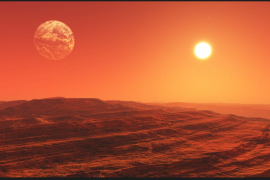
However, if you were on Mars, Phobos would appear huge, about a third the size of Earth’s Moon, while Deimos would look like a bright star drifting slowly across the sky.
Phobos rises in the west and sets in the east twice a day. Deimos rises in the east and sets in the west once every two and a half days. Watching them from the Martian surface would be a surreal experience.
Phobos Up Close: A World of Grooves and Shadows
High-resolution images from Mars Express show that Phobos’ surface is riddled with grooves, ridges, and impact craters. The largest crater, Stickney, dominates one side of the moon and measures about 9 kilometers (5.6 miles) across, nearly half of Phobos’ diameter.
These grooves may have formed from the shockwaves of that massive impact or from tidal stresses as Phobos slowly spirals toward Mars.
Inside Stickney Crater, boulders the size of buildings cast long shadows across the dusty plain. From orbit, Phobos looks like a ghostly, scarred relic, a survivor from the solar system’s violent youth.
NASA’s Mars Global Surveyor captured some of the most detailed views of Phobos, showing that it’s covered in a fine layer of regolith, dust likely produced by micrometeorite impacts.
Deimos: The Quiet Companion
Deimos doesn’t have the dramatic grooves or deep craters of Phobos. Instead, its surface is smoother, with fewer large impacts.
Because of its low gravity, debris from impacts often escapes into space instead of piling up, leaving shallow craters and dust-filled basins.
Deimos’ two largest craters, Swift and Voltaire, are only a few kilometers wide — tiny by planetary standards.
It’s a gentle world, quietly orbiting Mars for billions of years, untouched by the chaos of its sibling.
The Strange Dance of the Mars Moons
One of the most fascinating aspects of Phobos and Deimos is their contrasting motion.
Phobos orbits faster than Mars rotates, so it appears to move backward across the sky.
Deimos orbits slower than Mars’ rotation, so it moves forward, rising in the east and setting in the west.
To a future astronaut standing on Mars, Phobos would zip overhead and vanish below the horizon in just four hours. Deimos would linger for days, gliding gently across the stars.
It’s a dance of extremes, fast and slow, doomed and free, close and distant.
Could Mars’ Moons Support Exploration?
Both moons have drawn interest from space agencies as potential stepping stones for human exploration.
Landing on Phobos or Deimos would be far easier than landing on Mars itself because they have almost no atmosphere and extremely low gravity. Spacecraft could hover or gently touch down with minimal fuel.
NASA has studied the idea of using Phobos as a base camp for Mars missions. Astronauts could study Mars from orbit, tele-operate rovers, and test technologies for longer missions, all while staying in a safer, lower-gravity environment.
The Japanese MMX mission mentioned earlier will help test landing systems and collect samples that may tell us what these moons are made of, valuable data for future missions.
The Fate of the Moons
Phobos’ story is tragic but spectacular. As it continues to spiral inward, it will either collide with Mars or break apart under tidal stress. If it shatters, the debris could form a temporary ring system around the planet, something Mars has never had in modern times.
Deimos, on the other hand, will drift farther away, slowly leaving Mars’ gravitational influence. In billions of years, it may wander off into the solar system as a lonely rogue moon.
Together, these fates remind us that even moons live dynamic lives, constantly shaped by gravity and time.
What Mars Moons Teach Us About the Solar System
Studying Phobos and Deimos helps scientists understand not just Mars, but how moons form and evolve around planets.
Their shapes and compositions are windows into the early solar system, leftovers from when dust and rock collided to form the planets.
If they turn out to be captured asteroids, it means Mars once had the right gravitational pull to snatch passing rocks from space. If they’re made from Martian debris, they show how powerful impacts can reshape worlds.
Either way, these two moons are cosmic storytellers, quietly orbiting and holding secrets of creation.
Fast Facts About the Moons of Mars
| Property | Phobos | Deimos |
|---|---|---|
| Discovered | 1877 (Asaph Hall) | 1877 (Asaph Hall) |
| Name Meaning | “Fear” | “Panic” |
| Diameter | 22.4 km | 12.4 km |
| Orbit Distance (from Mars center) | 9,378 km | 23,460 km |
| Orbital Period | 7.66 hours | 30.35 hours |
| Gravity | 0.0057 m/s² | 0.003 m/s² |
| Surface Composition | Carbon-rich rock and dust | Similar composition |
| Surface Temperature | −112°C average | −120°C average |
| Orbit Direction | West to East (rises in west) | East to West (rises in east) |
| Fate | Spiraling inward; may crash or form ring | Drifting outward; may escape orbit |
Seeing Mars’ Moons from Spacecraft
Several spacecraft have captured close-up images of the moons of Mars:
Viking Orbiters (1977): First detailed photos.
Mars Global Surveyor (1998): High-resolution surface mapping.
Mars Express (2004–present): 3D models and close flybys.
MAVEN and Hope Missions: Occasional photometry and shadow observations.
These missions showed how the moons cast tiny shadows on Mars during eclipses. The shadows sweep across the surface in seconds, an otherworldly event that reminds us how small these moons really are.
A Sky with Two Moons
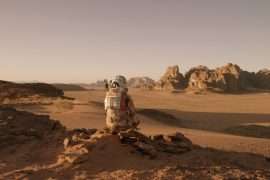
Imagine standing on the Martian surface during twilight. A pale red horizon fades into purple. Above, Phobos rises, big, dark, and fast. In a few hours, it races overhead and disappears. Later, Deimos glimmers faintly like a shy companion star, tracing a slow arc through the night.
That’s the view future astronauts may experience, a sky with two moons, each with its own rhythm.
It’s a sight no one has yet seen in person, but it’s coming. Mars’ twin moons are waiting.
Final Thought
Phobos and Deimos may be small, but their stories are vast. They remind us that even the tiniest objects in space can hold immense significance.
As we continue to explore, sample, and map these moons, we’re not just studying Mars, we’re uncovering how solar systems form, how planets change, and how even a dusty little world can have companions worth writing about.
Next time you see Mars glowing red in the night sky, imagine those two tiny moons racing around it, one rushing toward its destiny, the other drifting into eternity. Two fragments of fear and panic, forever circling the planet of war, and forever capturing our imagination.